
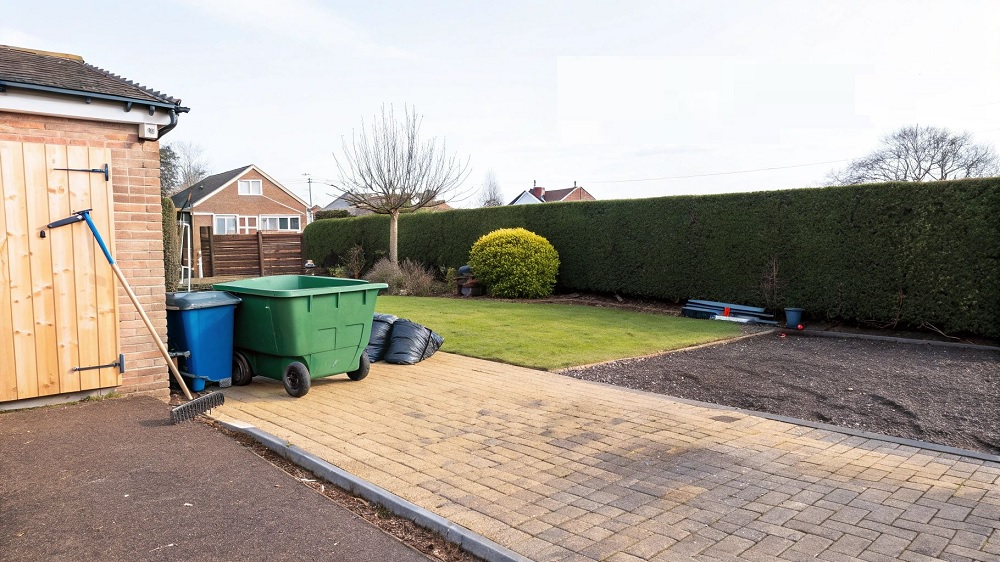

Many backyard renovation guides mention pavers and pergolas as if the green waste generated would be a minor issue. This is not the case. The green waste is what really defines how much money and time you will have to spend and if you can dispose of it in a skip or if you have to make three runs in panic to the tip with the trailer on a Sunday.
Start With a Waste Audit, Not a Mood Board
Before you touch a shovel, walk the yard and tag every feature by what it’ll become once removed. Lawn, hedges, dead trees, pavers, old soil, that rotting garden bed frame, each one belongs to a different disposal category, and knowing this upfront changes how you sequence the whole job.
This is the green waste stream audit, and it’s the single most useful planning step most homeowners skip. Estimate rough volumes in cubic metres for each category: organic matter, hard waste, contaminated materials, reusable soil and hardscape. You don’t need to be precise. You need to know, roughly, whether you’re dealing with two trailer loads or twelve, because that number decides whether council bins are enough or whether you need something bigger.
Skipping this step is how people end up with a mountain of clippings on day three and no plan for where any of it goes.
Sequence by Hazard, Not by Looks
Once you’ve got your audit, don’t start with whatever looks easiest to knock over. Start with anything that might be contaminated. Treated timber sleepers, old painted fence panels, anything that might contain asbestos sheeting under a lean-to or garden shed, these materials can’t go anywhere near your green waste bin or a standard skip. They need licensed disposal, and finding a facility that’ll take them takes longer than finding one for garden clippings.
If you demolish the hazardous stuff last, you’ll have already filled your bins and trailers with everything else, leaving no room to isolate the material that actually needs special handling. Get the contaminated waste identified and set aside first, even if it just sits in a tarp at the side of the yard for a few days while you sort the rest.
Handling the Loads Nothing Else Will Take
Every renovation generates the rubble that doesn’t fit nicely into a wheelie bin, a trailer, or a depot drop-off. All those stump grinding cuttings, those dense root balls still tangled with soil and rock, broken concrete slab corners, old retaining wall blocks, these are heavy, awkward, and often too big to lift without equipment.
This is the portion that folks often miscalculate when they’re estimating removal volumes, and it’s the part of a reno project that turns a weekend job into a three-week-long slog. Guess wrong and you’re looking at a fortnight’s work just hauling the junk away in suitable amounts, at the approved times, to the right tipping face.
This is the point at which DIY removal becomes unsustainable, particularly in a tight urban setting where the trailer is three backyards away from the road and the loading zone. Commercial Rubbish Removal Services Sydney trucks are designed to access awkward sites, have the disposal licenses for mixed plus hazardous waste, and get it all in one trip rather than the six you’d lose humping that stump and its root ball backwards and forwards in the tray of your Hilux.
The way to go about it is to schedule professional removal at the end of a demolition day, not halfway through. If you bring in the trucks mid-renovation, you’re going to have to double-handle everything, moving it once to a holding pile, then again onto their truck. Consolidate everything oversized into one spot, finish the rest of the day’s demolition, then bring in removal once for the genuinely unmanageable remainder.
Sort Clean Organics Before They Become Rubbish
This is where most renovations flush money down the toilet without realising it. Not all green waste is equal, and treating it all as ‘stuff for the tip’ ignores three cheaper or free disposal channels sitting right in front of you.
Small prunings and grass clippings can go straight in your council’s FOGO bin, so long as you’re not over the weekly volume limit. Healthy branches too big for FOGO but not diseased can be chipped into mulch and returned to your garden beds, either through a hired chipper or as part of an arborist waste agreement, whereby the tree contractor chips on site and leaves the material. Diseased plant matter is the exception, that needs to go to a municipal facility, not your compost, because home compost rarely gets hot enough to kill off pathogens or seeds.
NSW EPA estimates suggest anything up to 25-30% of what typically ends up in household garbage bins is food and garden organics, material that could have been diverted through composting or green waste instead. It’s a helpful stat to recall halfway through a renovation: every barrow of clippings that goes into a red bin rather than into a FOGO bin or compost heap is landfill volume generating methane for no good reason.
Know Your Bin Limits Before Demolition Day
FOGO bins may be big but they’re not bottomless, and tolerance for contamination varies between councils, so do it right the first time. Most councils provide an A-Z tool on their website. Waverley, for instance, doesn’t want any kitchen waste, animal droppings or retreated timber in their bins, but those last two are fine with Inner West, although they’ll draw the line at soil and concrete. Get this wrong, and put a contaminant in over a long weekend, and you can expect a full week’s postponement before you’re finally able to get it collected. And even with low minimum rentals, that’ll cost you.
Skip Bin Math vs Trailer Runs
The typical reaction is to rent a skip bin: it seems like the easy option, and sometimes it is. But for most suburban-sized jobs, the expense of a series of consolidated trailer runs to a local green-waste recycling depot is lower. This is particularly the case with the many Sydney council-run depots where organic waste is taken for free or a subsidized rate from local residents.
However, the maths only stack up if you’re consolidating. One trailer run for half a load and the dollars you saved on the skip bin disappear in the extra fuel and time you burnt on a run that should have carried double the material. Instead, build a holding area in the yard where organic waste can accumulate and only make a depot run when you have a full load on board. The zero idle rule: no run to the depot or the tip with anything less than around the vehicle’s limit.
Skip bins pay for themselves when the job involves large continuous quantities of mixed waste, or if you don’t own a car capable of trailer runs. For a staged demolition, where you are separating organic waste from hard, trailer runs and free depot drop-offs will probably be cheaper than a bin.
Weeds That Don’t Belong in Your Compost
Not all plant waste that you pull out is safe to put in your kerbside green bin or home compost system. For example, bamboo and lantana are among some of the common backyard baddies across Sydney. Both of these will re-propagate from root or stem material and quickly become a worse problem than they were to start with. In the case of bamboo, you may not even notice the little shoots popping up in the wood chip until it’s too late and you have a whole patch growing again.
Instead, bundle this kind of waste material and take it to a municipal green waste facility that heat-processes material at temperatures high enough to kill seeds and roots. During the audit stage, bag these species separately so they don’t get mixed in with your clean prunings. Don’t be tempted to leave the woodchip from them lying around the yard “to break down naturally.” It won’t break down before it re-sprouts.
Retain What You Can Reuse
Not all “rubbish” is really garbage. Topsoil that was removed before leveling the lawn, old bricks, and clean gravel can all be repurposed if you store it properly and don’t just haul it to the landfill. Chances are you’ll want topsoil again when it comes time to plant, and buying your own soil back after you already paid to get rid of it is a hidden cost most of us only consider after the fact.
Put all three of these materials into the corner of the yard, cover them if rain is on the way, and think of these things as inventory, not waste. You might also want to check local freecycling sites if you find you have more bricks or gravel than you can use on your own project.
Plant For Less Waste Next Time
The last step of the renovation is the one that could prevent you from ever having to do this all again. If you opt for local, slow-growing species and permeable ground covers instead of fast-growing hedging or thirsty lawn, the amount of pruning and clipping your yard generates from the following year onward can be drastically reduced.
A low-maintenance, endemic filled yard might only produce a fraction of the green waste that your high-maintenance, overgrown garden did, meaning fewer FOGO bin spills and far fewer trips to the depot in the future. The one part of the plan that rewards you every season, not just the one you put the effort in.
A backyard overhaul generates far less mess when the waste plan leads the demolition plan, not the other way around. Audit first, separate on type, load every trip to the max, and only call in the trucks for what you genuinely can’t shift yourself. The yard gets cleared once, properly, instead of six times when you’re knackered.
Comments are closed.